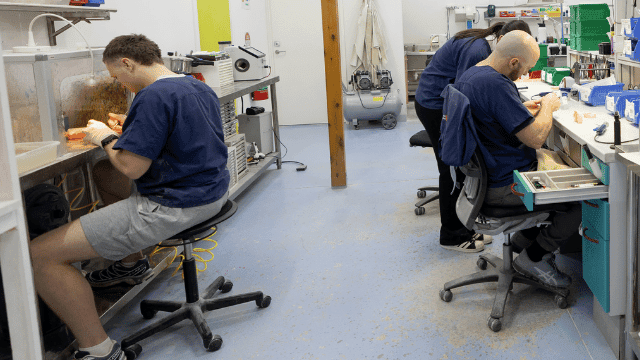

Most clinics don’t switch labs because of one bad case. They switch because a string of small frictions finally adds up to a pattern — and someone finally says it out loud.
The tricky part is that none of these frictions look like a crisis in the moment. A remake here, a late case there, one more follow-up call your front desk didn’t have time for. Individually, they’re forgettable. Add them up over a quarter and they’re often the single biggest drag on how smoothly your clinic runs.
If you’re running 20+ cases a month, your lab relationship isn’t a side detail. It’s part of your operations. Here’s how to tell if yours is quietly costing you more than it’s worth.
The real cost of running multiple labs
Every extra lab relationship adds a handover point. And every handover point is a place where a case can go wrong — a script gets misread, a shade doesn’t match, a file format doesn’t translate cleanly between systems. None of this shows up on an invoice. It shows up as a remake, a delay, or a patient back in the chair for a fitting that should’ve worked the first time.
Multiply that across three or four labs and you’re not managing a supply chain — you’re managing three or four sets of turnaround times, three or four communication styles, three or four sets of excuses when something slips. For a time-poor dentist, that’s not resilience. That’s admin.
1. Your remake rate is creeping up
One remake is a mistake. A pattern of remakes is a process problem — somewhere between the script, the prosthetics or appliance build, and the fit, something isn’t translating cleanly. Every remake costs more than the redo itself: a second patient visit, a delayed case, chair time spent fixing instead of treating, and a patient who’s now waited twice for something that should have taken one visit. If you’ve stopped being surprised when a case comes back wrong — if it’s become a line item you just budget for — that’s the flag, not the remake itself.
2. You can’t predict turnaround anymore
A reliable lab gives you a number you can actually plan around. If your turnaround time varies case to case with no clear reason, you’re not scheduling patients — you’re guessing, and building in buffer days “just in case” that quietly eat into your capacity. Digital workflows (scan to design to print) are what make turnaround consistent and quotable in the first place. If your lab still can’t give you a straight answer on timing, or the answer changes depending on who you ask, that’s worth questioning — and it’s worth asking why the digital side of their process isn’t doing more of that work.
3. Your team is the one chasing updates
In a working partnership, status updates come to you. In a struggling one, your front desk or chairside team spends time every week calling, emailing, or following up just to find out where a case is. That’s not customer service — that’s you doing the lab’s job of keeping you informed, on top of your own. Add it up across a team and a month, and “just a quick check-in” is real, paid staff time that isn’t going toward the clinic.
4. Results are inconsistent case to case
Same appliance type, same clinician, different outcomes. Inconsistency is often a sign of manual handoffs or outsourced production steps — more hands touching the case, more facilities involved, more room for variation to creep in between one case and the next. Fully in-house, digitally-driven production (like occlusal splints built end-to-end in one lab) tends to produce far tighter consistency than work that passes through multiple hands or gets sent offshore partway through.
5. Communication feels like a black hole
You don’t know who’s actually working on your case. Questions take days to get answered, or get answered by someone different every time, with a different version of the story. A lab that’s genuinely built for high-volume clinics operates with a direct point of contact — not a ticket queue and not a rotating cast of account reps — because at 20-30+ cases a month, ambiguity is expensive and slows everything else down.
What this adds up to…
None of these five signs is fatal on its own. Together, they’re a pattern — and the pattern has a cost: remakes eating chair time, buffer days built into every schedule “just in case,” staff hours spent chasing instead of treating, and a clinician quietly working around a lab instead of relying on it. For a clinic running real volume, that’s not a minor inefficiency. It’s a recurring hit to capacity and margin, month after month, that rarely shows up as a single line on a P&L — it just shows up as a clinic that runs harder than it should.
If two or more of these sound familiar, it’s worth asking whether your current lab relationship is actually built for a clinic your size — or whether it’s just the one you’ve always used because switching felt like more hassle than living with the problem.
Try Australian Dental Labs – see the difference for yourself ↓