
Overseas lab work is cheaper. That part’s true. What doesn’t show up on the quote is what you pay for it in turnaround — and for a clinic running real volume, turnaround is the whole game.
A few dollars off a crown looks like a win until you calculate what a week of extra shipping time actually costs your appointment book.
The turnaround gap is bigger than it looks
A local, digitally driven lab can turn a straightforward case around in days—scan to design to print, with no freight in between. Send it overseas, and you’re adding shipping both ways, customs clearance, time-zone lag on any query, and a queue behind other clinics’ cases at a facility you’ve never seen.
Add it up and what looks like “a bit slower” is often the difference between a two-week case and a four-to-six-week one. For a one-off case, that’s an inconvenience. For 20-40 cases a month, that’s a permanent drag on how many patients you can actually get through treatment.
What the delay actually costs you
Buffer days you didn’t choose. When turnaround is unpredictable, you don’t schedule around the lab’s stated timeline — you schedule around the worst case. Every buffer day you build in “just in case” is a day you’re not booking, on every single case.
Remakes take twice as long to fix. A remake from a local lab costs you days. A remake from overseas costs you the full round trip again — another few weeks, another patient back in the chair for something that should’ve been right the first time.
Patients who don’t wait. A patient told their crown will take six weeks has time to think about whether they still want it, shop around, or simply not come back for the fit appointment. A patient told two weeks stays booked.
No one to actually call. When a local lab has a question about your script or your shade, they call you — same day, same time zone. When an overseas lab has a question, it sits in a queue until someone’s awake on the other side of it, and your case sits with it.
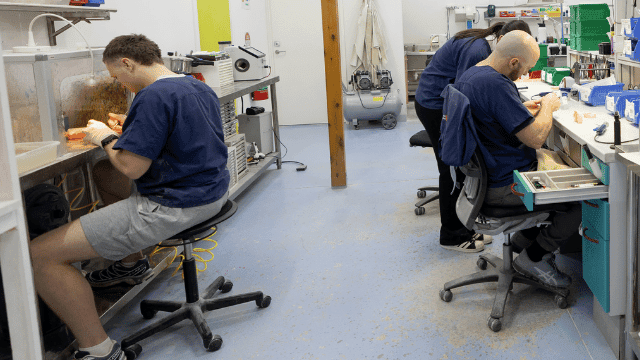
Quality control you can’t see. You can visit a local lab. You can ask who’s building your case and how. With an offshore facility, you’re trusting a process you’ve never seen, run by a team you’ll never meet, on a timeline you don’t control.
Why “cheaper” doesn’t mean “cheaper”
The invoice is only part of the cost. The real cost is chair time spent on remakes instead of treatment, buffer days that shrink your booking capacity, and patients who lose confidence in a process that keeps them waiting. None of that shows up on a per-case price comparison — it shows up in your P&L at the end of the month as a clinic that’s running harder for less output.
For a high-volume clinic, a lab isn’t a place you send cases to save a few dollars. It’s part of how many patients you can treat, how predictable your week is, and how much your team spends chasing versus working. Save $20 a unit overseas and lose two extra chair-time slots a week to remakes and delays, and the “cheaper” option was never actually cheaper.
What to look for instead
A local, digitally-driven lab that gives you a real number on turnaround — not a range. One that answers the phone in your time zone. One you could walk into if you wanted to. That’s not a nice-to-have for a clinic running 20+ cases a month. It’s the difference between a lab that supports your capacity and one that quietly caps it.
We built Australian Dental Labs to be exactly that kind of partner — local, digital-first, and built around the clinics that actually need reliable turnaround, not the ones happy to wait and see.
Send a case. See the turnaround for yourself.